Two music graduates chronicle the culinary delights of Leeds and London and explore the height of fine dining on a limited budget.

Good food is well punk.

September 15, 2010

Linguine All' Espagnola

Again, apologies must come for not updating this more in recent weeks - now that the kitchen's finished I am able to cook again, but I hardly seem to be making incredibly exciting food worth writing up. In any case, enjoy this pasta dish I whipped up the other day. My pidgin Italian probably doesn't make any sense, but that's just the way I roll. The dish takes its cue from the classic All' Arrabiatta sauce, so I just bastardised it for my own ends. I'd like to think I picked this meal up during the few times I've been to Spain (and subsequently fallen in love with the country and its cooking) but most of the time I was there I was too pissed on Sangria to cook. Oh well.

Serves 2

200-250g Linguine
2 Medium Onions
4 Cloves Garlic
2 inches chorizo
1 tsp Dried Thyme
2 tbsp Tomato Puree
2 Chillies (optional)
2 Egg yolks

Set a large pan of salted water on to boil for the pasta, and cook until al dente according to packet instructions. When draining the pasta, reserve a mug of the starchy water, and add to the pasta again once it's fully drained - this stops the pasta from sticking in the saucepan and helps the sauce to coat it. While the pasta boils, prepare the topping. Dice the chorizo as finely as possible and fry gently in a little olive oil for a few minutes. Finely slice the onion and add to the frying pan once the chorizo's starting to release its fat. Keep frying on a low heat, finely chop the garlic and chillies and add to the pan as well, along with the thyme and tomato puree. When everything's all nice and soft and orange, stir it into the pasta, and serve. While it's still hot, place an egg yolk on top of each serving, and beat it in with your fork. Season generously with black pepper, and enjoy.


The addition of raw egg may seem strange (and not for the faint-hearted) but the residual heat of the pasta cooks it, and it adds a lovely richness to the meal. Definitely not one if you're watching your cholesterol, but what the hell. It's only lunch.

August 31, 2010

No Beans About it: A Simple Pork Casserole

Apologies for the lack of updates recently, but rather selfishly my parents have decided to knock out the whole back of the house and redo the kitchen at the very same time that I moved back home from Leeds. The upshot of this is that we've been surviving on baguettes from the local French deli and microwave meals. Shudder.

In any case, I was finally allowed into the kitchen the other night to use the new fridge and hob. Limited for space amongst the dusty surfaces and power tools, I had to make something that wouldn't require too much preparation and had little chance of spoiling or getting dust in it. I came up with this.

Serves 4

4 Pork Chops (or similar amount of diced pork)
50g Prosciutto (or lardons, or diced smoked bacon)
1-2 Red onions
1-2 Red Peppers
2 Cloves Garlic
1 Tin Red Kidney Beans
Olive Oil

Firstly, begin by chopping up the pork. I divided each chop into three as a compromise between reducing the cooking time and having a having something large to get your teeth into. Heat a small glug of oil in a casserole dish and brown off the pork. There's no need to cook it all through, just let it take on colour. Remove and set aside on a plate.

Throw in some more olive oil, thickly slice the onion and roughly chop the pepper and add to the pan when the oil's ready. Add the prosciutto (diced if not already), and cook for about 5-10 minutes, until the onion begins to soften. It might seem somewhat excessive to have two kinds of pork in the dish, but it's really important to incorporate the smokiness into the dish. Finely slice the garlic and add to the pot. Rinse the beans, and add when the garlic just starts to brown and become aromatic. Add the reserved pork, refill the bean tin with water, and fill the casserole dish until the food is completely covered in liquid. At this point you might want to add some herbs or paprika, but I think this dish has enough in it to let the taste of the pork shine through.


I neglected to take a picture, so enjoy this mercilessly stolen shot of some bacon being chopped up 

Simmer as long as you can bear, but for at least half an hour. The idea is the reduce the liquid in the pot until it thickens from the partially dissolving kidney beans. As with all stews, it's not an exact science; add more water if you feel it needs it, cover the casserole if you feel it's evaporating too rapidly. You'll want to scrape the bottom now and then to avoid the food burning, but don't be too much of a zealot about this. The burnt bits at the bottom are often the best part. When it's done, serve with rice, polenta or crusty bread.

Like all stews, it was eaten in a far shorter time than it took to make it. But that's no bad thing, as by that point we were completely ravenous. A few glasses of red wine and immediately the house began to feel like a home again.

August 06, 2010

Pretty Grand: A Tale in Dining On the Go

There's a certain terrible transience that necessarily comes with any area associated with transport. I suppose that's a bit obvious really. But stopping to seriously consider the matter, it is a symptom of the modern world that we can never find the time to sit down and relax whenever we try and go anywhere. Consider Heathrow's Terminal 5 - supposedly a multi-million pound luxury hotspot to facilitate the mass transport of holidaymakers, the sheer amount of bloody chain restaurants and overpriced tourist shit make it an even more stressful entry on the bulletin list of enforced foreign relaxation.

St Pancras railway station is similarly marketed as some kind of boutique haven; a place where trendy young women in heels and silk scarves relax before a trip up north by filling their Louis Vuitton suitcases with yet more designer clobber. Instead I find the whole setup rather depressing - as lovely the architecture may be (and so far removed from horrid King's Cross next door) the whole place smacks of desperate consumerism. All the typical high street chains are crammed into brick alcoves; there's only so many Moleskines a man can take.

Upstairs, however, is home to the St Pancras Grand, a restaurant that holds the accolade of being able to rob me of my London cynicism for a few precious hours. It may be yet another chain (part of the Searcy brand) but the restaurant has a notable individuality that extends purely beyond its delightful location. Situated opposite the Eurostar trains bound for Paris, there is a definite Gallic air to the place, and the inside is done up like an old continental art deco establishment. Save for the Chip & Pin machines, you could be mistaken for thinking you'd fallen into a wormhole to the 1930s. I half expected to turn round and see Agatha Christie dining with James Bond at the table across from us.

The à la carte menu isn't exactly cheap (expect to pay £14-20 for a main course) but we were able to take advantage of a seriously good offer by booking through Toptable. £15 for a two course meal with complimentary glass of "pink fizz"? Yes please. The cheap menu was obviously fairly limited, with a choice of three for both starters and main course, but the old adage "you get what you pay for" is fairly appropriate. And since what you pay for is a rather delicious meal, there's no harm in that.

I ordered the Cornish Brown Crab served with toast, but was told sadly that the dish wasn't on the menu that night, replaced by a rather delectable salmon, trout and saffron potato terrine. It was fairly great, if a little mild. Still, an absence of gutsy salt or lemon was made up for by a good whack of chives, bring the meal up to taste.

Roast chicken with bacon, croutons and a poached egg was the main course (narrowly beating a salmon fishcake). The chicken was beautifully soft, clearly slow-roast for a good length of time, and covered in a wonderfully deep and rich gravy that tasted faintly of mushrooms. The mildly vinegary poached egg was a slight anomaly perched on top of the delectable meal, but the yolk provided even more depth of flavour to the chicken.

Desserts are priced at £6.50, but they are (according to my younger brother) bloody good. I wouldn't know; I had an espresso and a brandy in what I hoped was a Mad Men-esque throwback to the days of the liquid lunch, but more likely made me come across as a slight alcoholic. Oh well.

So transient and vaguely corporate it may be, but you could do a lot worse if you feel like chilling out and stepping back in time during a hectic trip out of London.


St Pancras Grand
St Pancras Station
Upper Concourse
Euston Road
London
N1C 4QL
http://www.searcys.co.uk/stpancrasgrand/
0207 870 9900

July 24, 2010

From Bulgaria With Love: A Beginner's Guide to Shopska Salad.

With three years of higher education under our belts, my housemates and I (along with 6 other friends) recently spent a week on the coast of the Black Sea in Bulgaria sunning ourselves, drinking cheap lager and generally frittering away the remainders of our overdrafts.
"But why is he telling us all this!" I hear you ask through the magic of the internet. Well, obviously because we ended up spending the week surviving on Shopska, the national salad of Bulgaria. It may sound simple, and I'm not going to imply that simply chopping vegetables requires a recipe, but I felt the meal needed some kind of record for posterity. What can I say?

The key ingredient of the Shopska is the cheese, a type of brined white cheese called sirena. It's similar to feta, but less strongly flavoured, and generally made from cow's milk rather than ewe's. Any Leedsers should be able to pick something similar from the Maumoniat international supermarket, but the ubiquitous Feta should serve just as well.

Perhaps harder to replicate in Britain are the tomatoes. I don't think I've ever eaten a tomato from a supermarket that satisfied me in any way. I mean, sure, Sainsbury's flavouripe are alright in a bland sandwich, or drenched in dressing, but we just don't have the climate for producing tomatoes that actually taste of what they are. Oh well. It may be worth shelling out for. If you find a good source for tomatoes, let me know. In any case, the texture of the salad demands large and juicy tomatoes rather than small and fruity - if it wouldn't go in Maz's famed Tabbouleh, it wouldn't go in here.


Serves 10 as a starter, maybe 6 as a main.

1 block of Sirena cheese
1 large cucumber
2 Green or yellow peppers
2 red onions
4 of the freshest, best beef tomatoes you can find
1 tsp dried parsley
½ tsp dried oregano
6 tbsp sunflower oil
2 tbsp white wine vinegar
Salt and Pepper

Begin by chopping the cucumber, peppers and tomatoes into chunks about 1cm wide, and place in a large bowl - actual quantities don't really matter, but there should be a roughly even amount. Likewise, finely chop or slice the onions, add to the bowl and stir the mixture. Season well with salt (to bring out the juices) and set aside for a few minutes. 

To make the dressing, simply mix the dried herbs into the oil with a fork. Add some salt and pepper, slosh in the vinegar and shake vigourously in a glass jar. Pour most of the dressing over the mixture in the bowl. Either chop the cheese into large chunks or grate it over the salad - either way is fine, but we preferred the large chunks of salty goodness soaking up the dressing and tomato juices. Drizzle over the remainder of the dressing, and serve with bread and grilled meat.


I know, it doesn't look like much, but the way the saltiness of the cheese is matched by the acidty of the dressing and juice of the tomatoes is one of the closest sensations I've come to culinary perfection.

As a post-recipe bonus, have a picture of me making the salad, in a dodgy vest and using the knife found in our villa that we swiftly entitled "the Bitchfucker".

July 13, 2010

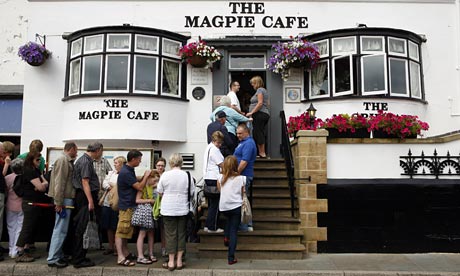
A Trip to Whitby: The Magpie Café

George Bernard Shaw, highlighting the inconsistencies of the English language, once proposed a new spelling for the fish: ghoti. That's gh as in trough, o as in women, and ti as in nation.

Spelling aside, the word fish has a great cultural resonance with the British. Say it. fshhhh. Instantly, the sound of the word conjures up little silvery things caught off the coast of Cornwall, or a river trout cooked over a barbecue in the New Forest. Perhaps more likely though, the sound and smell of a fillet of white fish frying in batter. Fish and Chips. The best thing we gave the world outside of Monty Python and football violence. Like McDonalds and chocolate, it is a meal that transcends boundaries of class and age. Who doesn't love tucking into a steaming crisp fillet, smothered in salt and vinegar, atop fried potatoes dripping in grease? Doubly so from a wrapper, at a bus shelter on a cold winter's night.


Yet Fish and Chips is such a widespread dish, there are surely infinite ways to get it right? And subsequently, get it wrong. We've all been there. The fish tastes dodgy, the batter falls apart and the chips are some godawful "french fries". How to get the meal right?

On a recent daytrip to Whitby, we ran into this very problem. Being a coastal town awash with tourists and old people on coasches, it has a glut of Fish and Chip emporiums, but only one of them has a large queue out the door on any given Wednesday afternoon. Situated literally opposite the fish market, the Magpie Café consists of a (rather swanky-looking) fish restaurant combined with a more typical Fish and Chip outlet. Clearly the stuff of local legend, we decided that it was the destination of choice for lunch.

We were proved entirely right.


The meal was perhaps the Platonic ideal of how Fish and Chips should be cooked. The cod (they'd run out of haddock) was perfectly flaky, captured in a large crunchy batter. The chips perfectly struck the balance between crisp and soggy, benefitting from being fried in what smelt like beef dripping. And the mushy peas. Oh, the mushy peas. Words cannot begin to describe quite how good the peas were. Suffice to say, they were the best. Absolute end of.

Of course, such culinary perfection comes at a price. But that price is an absolute steal. At £4.40, the fish is slightly above the average, but so completely worth it in every way. Cod, chips, mushy peas, tartare sauce and a can of shandy came to just under £8. Eaten on the beach with a healthy pinch of sand the sea breeze in my hair. Paradise.

Interestingly, had I been served a battered ghoti, the chips would have been made out of ghoughpteighbteaus*.

The Magpie Café
14 Pier Road
Whitby
North Yorkshire
YO21 3PU

*Hiccough, though, ptomaine, neigh, debt, bureau. Tenuous yes, but roll with it.